-medium.jpeg)
Lodging resistance starts from the ground up - with the roots
Story written by Bruce Barker | The Canadian Agronomist
Lodging is one of the bigger challenges barley growers have to contend with. Managing lodging is often a balance between pushing nitrogen fertility to maximize yield – or going too far and suffering yield losses due to lodging.
“Barley lodging is a high priority for the breeders. Yield loss would definitely be expected if you have lodging, and depending on what time of year it happens and how severe, 40 per cent loss is possible,” says Dr. Aaron Beattie, associate professor and Ministry of Agriculture Strategic Research Program Chair in Barley and Oat Breeding and Genetics at the University of Saskatchewan.
“Even if the yield loss isn't quite that devastating, you're probably going to have other issues with increased disease load on the plants, and some cost associated with taking longer to harvest the lodged crop. If you're growing a malt crop, and it becomes more infected with Fusarium head blight, it could be downgraded to feed, and so you’re probably looking at around $200 per hectare on that alone, “ he says.
Traditionally plant breeders have focussed on selecting for stronger straw that can result in less stem breakage. But a difficulty with that approach is that during field selection trials, lodging doesn’t always occur. If you can’t see lodging, it’s hard to select for resistant cultivars. Barley breeders are left to subjectively estimate barley stem strength by running a hand across the plants to get a sense of its strength.
This challenge led Beattie to look for additional ways to improve barley lodging resistance. In 2020, he teamed up with Dr. Allan Feurtado, team lead for Integrated Omics and Climate Resilience at the National Research Council’s Aquatic and Crop Resource Development Research Centre in Saskatoon, for a three-year research project. The main objective was to investigate root and stem structural differences between barley cultivars and determine how these impact lodging and standability.
The research project was funded by Alberta Grains (then Alberta Barley), Western Grains Research Foundation, Sask Barley, Saskatchewan’s Agriculture Development Fund, and the Saskatchewan Cattle Association. The project assessed 13 barley cultivars for differences in root system architecture - the overall shape and spatial arrangement of the root system - using indoor growth chambers. The cultivars were hydroponically grown in file-folder-like paper pouches. This allowed the researchers to assess the 2-dimensional root structure of both seminal and crown roots using image analysis and determine which root traits were most strongly associated with lodging resistance.
The 13 cultivars were also assessed in three years of field trials for 12 stem and root traits to see which were best associated with lodging. The field results were also compared to the growth chamber work, which helped confirm indoor root imaging as a practical method for predicting lodging resistance.
“A MSc student investigated what traits were associated with lodging. Questions here were: How much of a role does stem failure play? How much do roots matter in terms of lodging, and what traits can we best associate to lodging when comparing traits such as plant height, stem strength, and spread of the root crown? Here it was determined that plant height and crown root angle (or root plate spread) played important roles in lodging resistance,” says Feurtado.
One of the findings of this project was that a wider seminal root angle coming out of the germinating grain, which spreads more horizontally, was an excellent predictor of better lodging resistance. Essentially, if the seminal roots are a wider angle, the crown roots are also wider, which allows the plant to grip more soil and achieve stronger anchorage.
“After we did this study, we hypothesized that maybe at one point in time stem lodging was an issue, but at least from the Canadian perspective, we've done a good job looking after that characteristic. As a result of having strong stems, we’ve transferred the burden of resisting that lodging force onto the root system,” says Beattie.
Beattie and Feurtado are now collaborating on a subsequent four-year Saskatchewan Agriculture Development Fund research project, initiated in 2024, to build on the finding that root system traits play an important role in barley lodging resistance. Other collaborators include Ian Stavness from USask Computer Science, Jordan Ubbens with NRC Saskatoon, and Ana Badea at AAFC Brandon. Funders include Alberta Grains, Manitoba Crop Alliance, SaskBarley, and Western Grains Research Foundation.
The research includes both field and indoor laboratory trials, similar to the first ADF project. This time, a more diverse barley population composed of 250 barley lines are being evaluated, with 169 lines assembled by Beattie’s USask- Crop Development Centre breeding program, and another 81 lines coming from Badea’s collection at AAFC Brandon.
These barley lines will again be grown hydroponically in indoor growth chambers to help evaluate the root system architecture. Building on the imaging analysis from the first study, machine-learning and artificial intelligence will be utilized to further assess which root traits can best predict lodging resistance in the field.
“Using AI is basically trying to get machines to look at the data in a way that we don't necessarily think of, and seeing if it can pull out information that we've missed,” says Beattie. “Root system architecture is very complex and so it is difficult to try and pull out information that can be predictive of lodging in the field.”
The collection of lodging data over three years from field trials will further correlate the findings to real world lodging outcomes. The results will also be used to identify genetic markers associated with root traits that are linked to lodging resistance, which will ultimately help with the development of new barley lines with better lodging resistance.
For barley breeders, the results will ensure more accurate selection for lodging-resistant traits in their breeding programs. This, ultimately, will mean farmers will have better lodging resistant varieties that provide a foundation to allow them to push for higher yields.
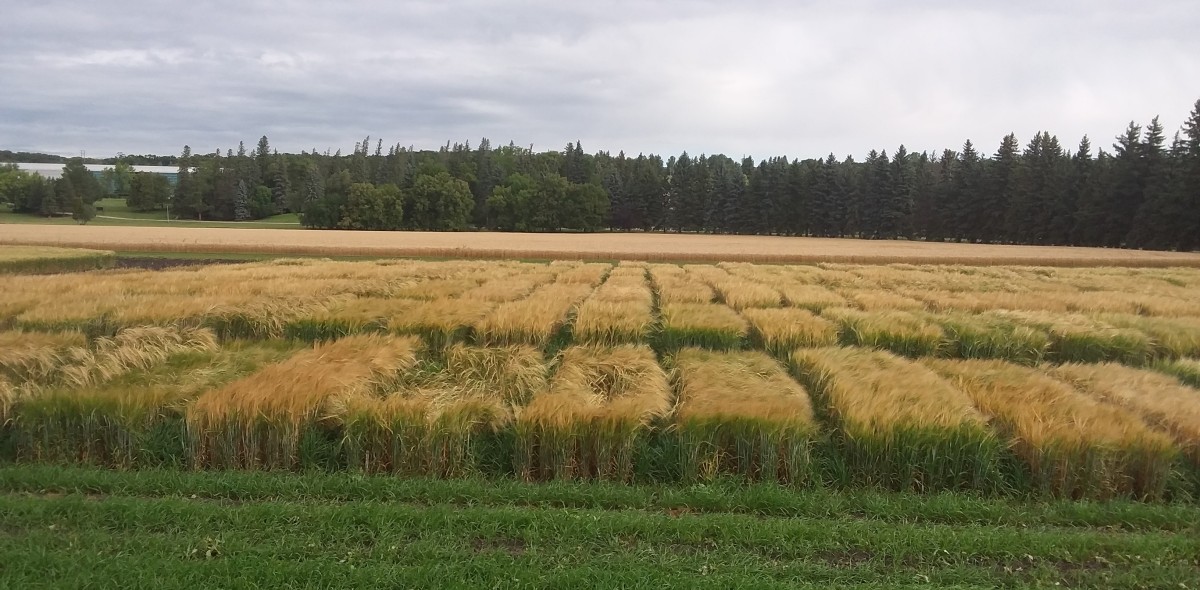
Figure 1: Field plots of the barley collection growing in 2025 at AAFC Brandon. Photo courtesy of Ana Badea.
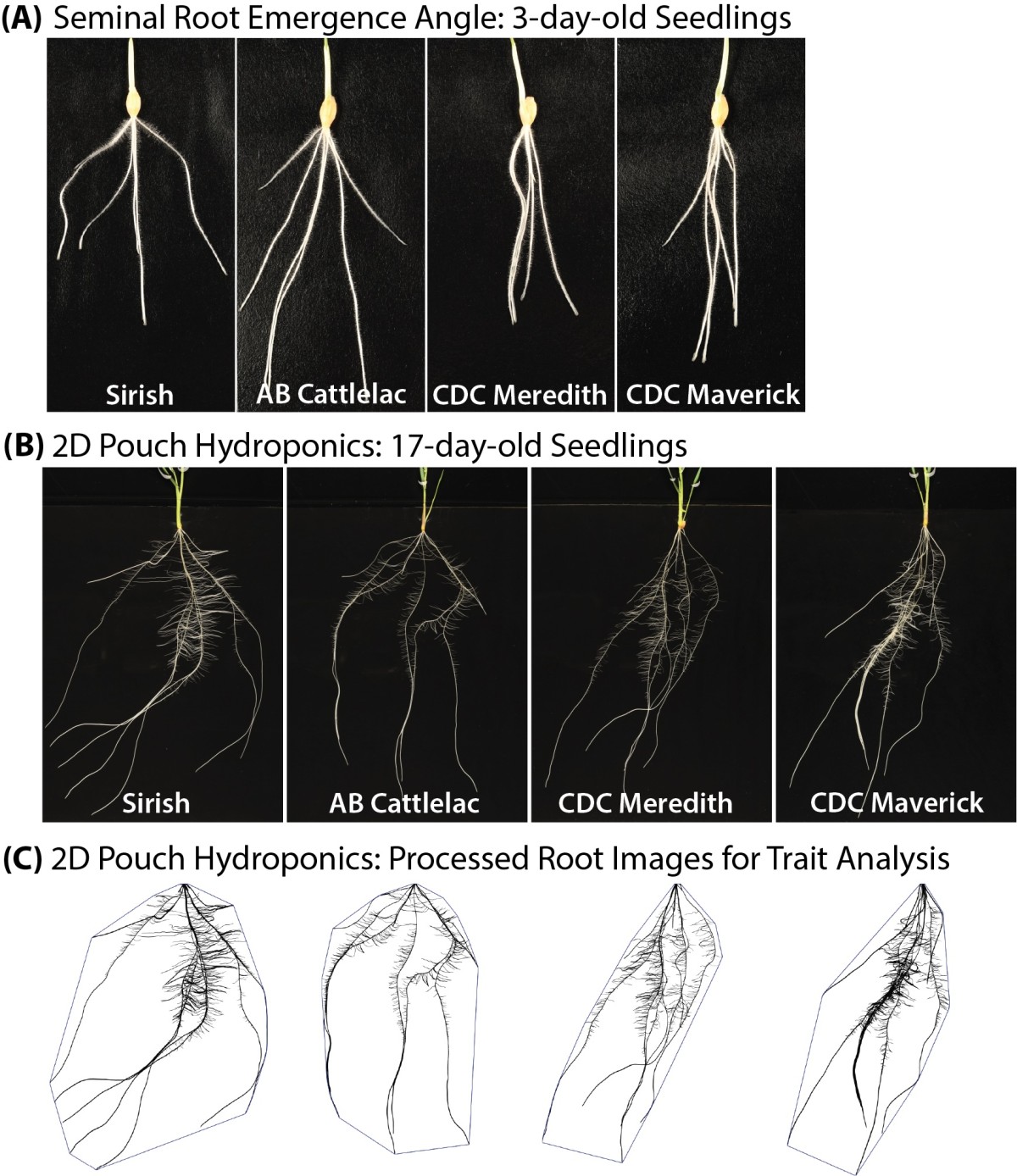
Figure 2: Root system images from 3-day germinating barley grain (A) and 17-day seedlings (B) including processed root images for analysis (C). Seminal and crown roots with wider angles like Sirish and AB Cattlelac achieve stronger anchorage for reduce lodging. Figure produced by Allan Feurtado and Shengjian Ye.