
Cereal insect pest outlook 2026
Cereal Pests Situation for 2026
Amanda Jorgensen, Insect Management Specialist, Alberta Agriculture and Irrigation
Cutworms
Start scouting early for cutworms in 2026! Egg-laying conditions for red-backed and dingy cutworms were ideal in the fall of 2025, so we may see those populations continue to increase in spring 2026. Be sure to check fields where large flocks of birds follow spring field operations. Scout carefully in fields with poor emergence or high winterkill.
Cereal aphids
High numbers of bird cherry oat aphids were reported in late 2025 in southern Alberta, and there were reports of fall-seeded crops exhibiting barley yellow dwarf virus symptoms prior to overwintering. If aphid migration is high in 2026, fall-seeded cereal crops could act as a reservoir for the virus this year. Management strategies for the virus include seeding spring wheat early and winter wheat no earlier than optimal timing and controlling grassy weeds and cereal volunteers. Controlling aphids through insecticides is rarely effective or economical. Once fields are infected, there are no effective control options.
Grasshoppers
Grasshopper risk for 2026 varies across the province. Fall conditions were favorable for grasshopper egg laying over most of the province. Spring hatch will depend on the number of grasshoppers in the area last fall and early spring conditions. Be prepared to scout for grasshopper nymphs, especially if spring 2026 is warm and dry.
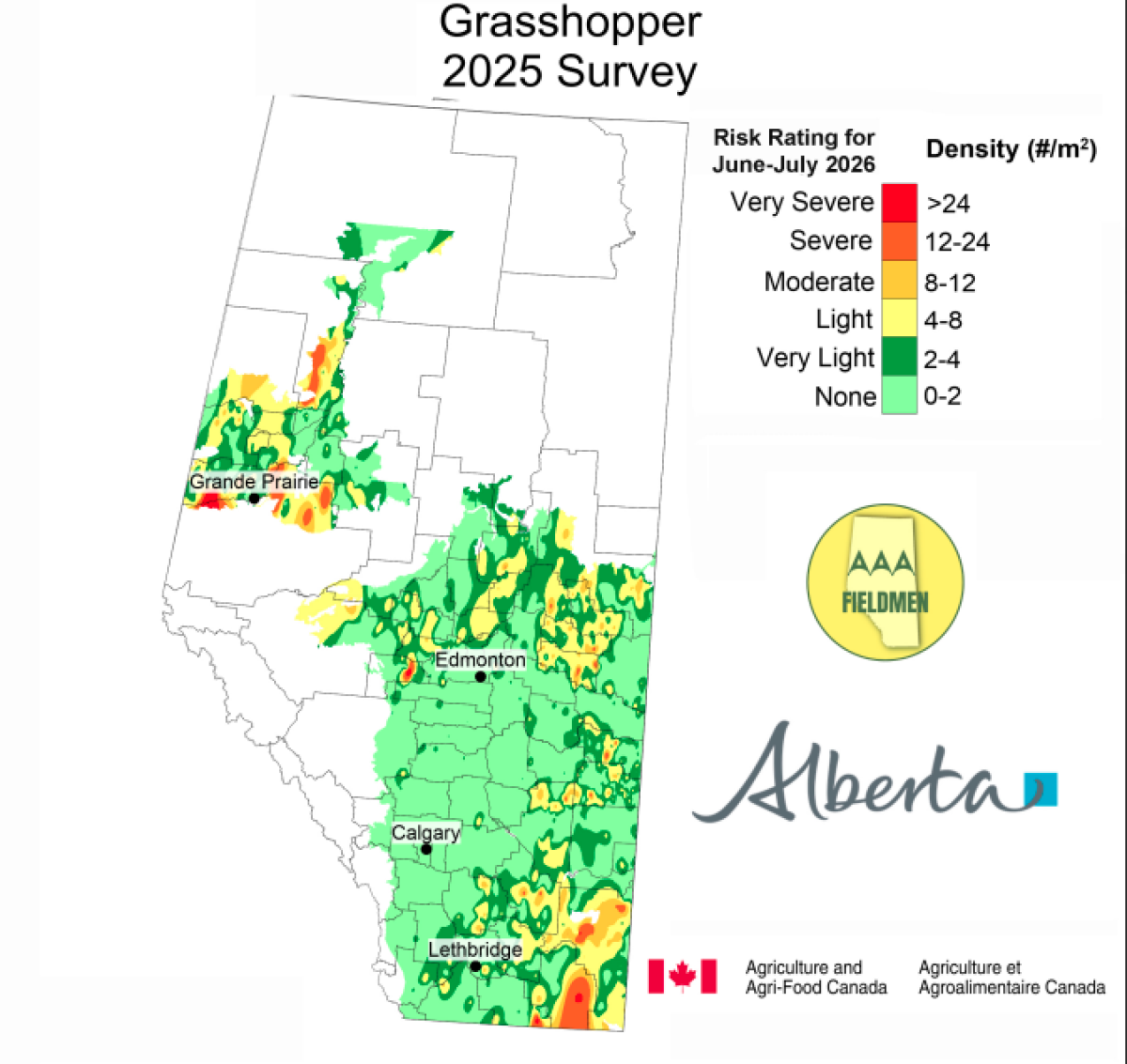
In the Peace region and northern Alberta, high populations in 2026 were driven by the Bruner’s spur-throated grasshopper, which seems to have a 2-year life cycle that peaks in odd years. Other species of grasshoppers were observed, so while populations should be lower in 2026, scouting will still be important.
Grasshopper populations were low in central Alberta but there may still be localized areas with higher numbers in 2026.
In southern Alberta, grasshopper numbers were comparable to the previous year. Grasshopper populations may increase in 2026, particularly along the eastern edge of the province.
Wheat stem sawfly
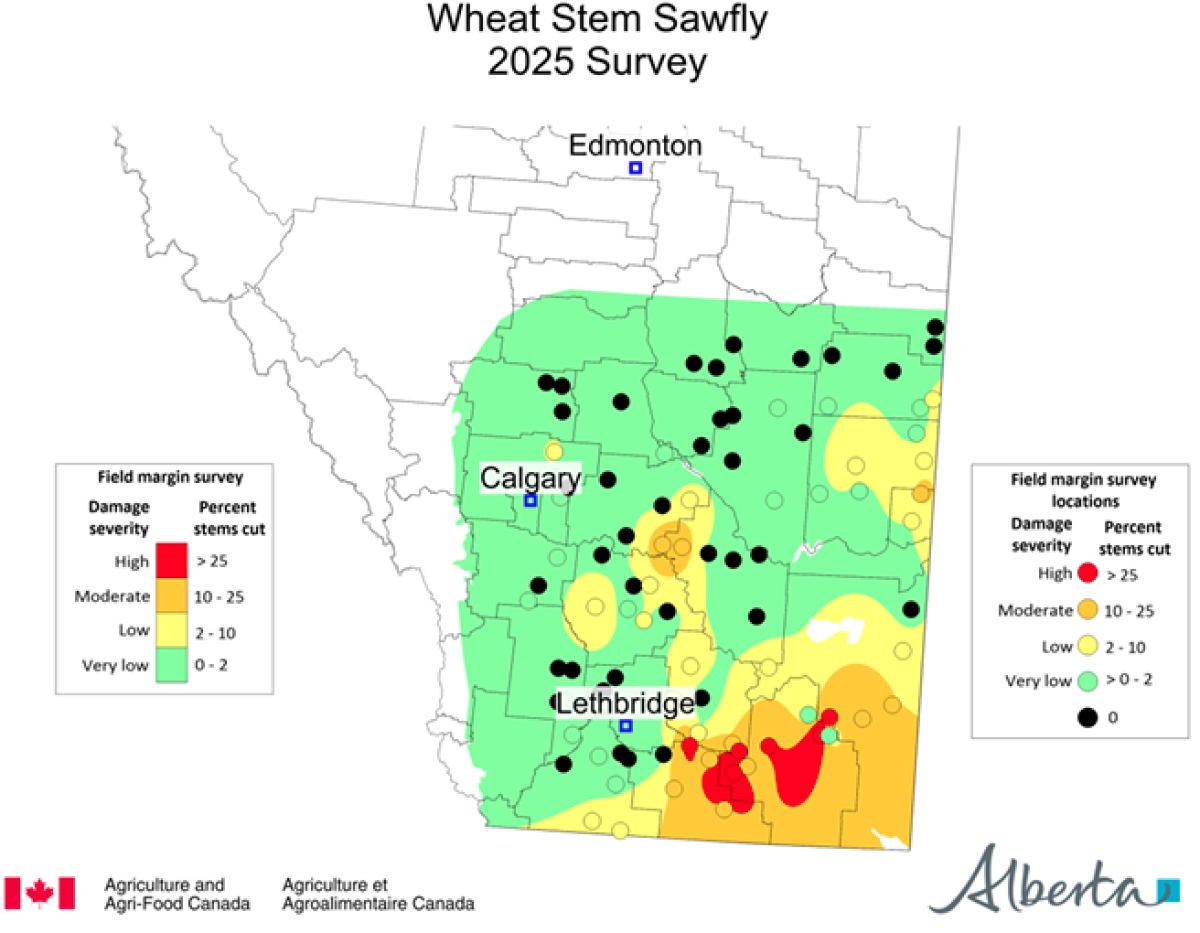
The extent of wheat stem sawfly damage continued to decrease in 2025. Traditional sawfly areas in Forty Mile and Warner counties did still have fields with high rates of damage. Producers who experienced more than 15 percent cutting in 2025 fields could consider using solid or semi-solid stem wheat varieties in 2026, rotating to a broadleaf (non-host) crop, or planting a trap crop like oats.
Reports of high rates of parasitism and disease burden were made for sawfly in 2025.
Wheat midge
Low populations of wheat midge were found across the province in 2025 with no distinct hot-spots. No midge cocoons were found in the Peace region. The number of parasitoids found in wheat midge samples increased in 2025, particularly in central Alberta. One quarter of infested fields had parasitoids present. In fields with parasitoids, between 25 and 50 percent of midge were controlled by the parasitoid.
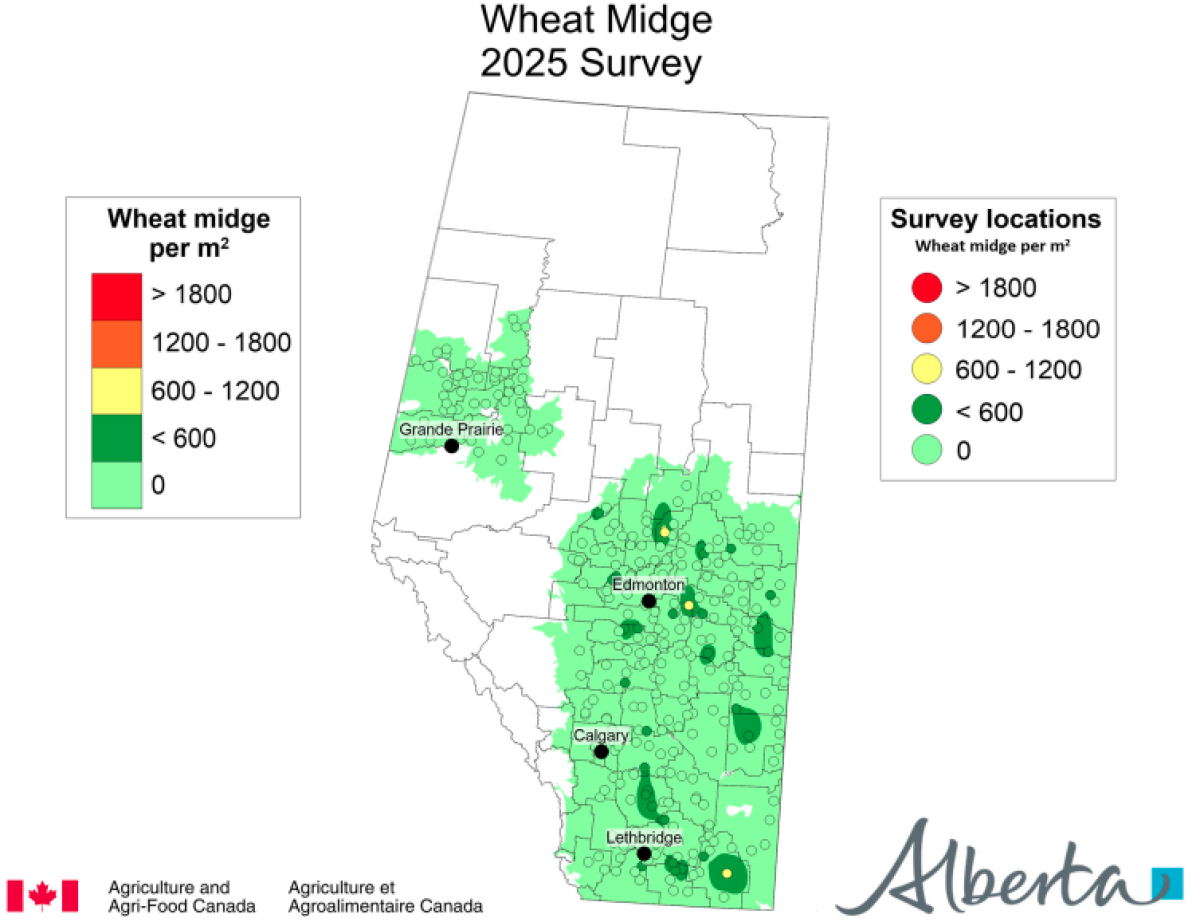
Individual fields may have high levels of midge, so producers should refer to 2025 and 2024 midge downgrading when making preventative control decisions, such as using midge-resistant varietal blends.
Wireworms
We’ve had multiple reports of above threshold wireworm populations in southern and central Alberta. There are no post-emergence options available for wireworm control, so scouting before seed is in the ground is critical.
Fields with a history of heavy grass or cereal production or that have had emergence/plant stand issues previously should be checked carefully for wireworms. While bait balls can be effective if there is little or no actively growing plants in the field; sifting a 10-inch deep soil sample taken with a shovel can provide a easy way to sample for wireworms.
As crops begin to emerge, watch for patches of poor emergence and check for wireworms and cutworms. If you see a flock of birds following equipment during field operations, it’s worth paying close attention to that field.
Report sightings here.
Sumbit a Crop Insect Report here.
Learn more here.