
How cereal varieties are registered and commercially released
Breeding a crucial part for producers and the agriculture industry. However, it is known to be a multi-year complex process. A lot of steps are required from the first cross to the registered new variety. In this article, we will look at the final stages before variety registration. How are varieties assessed before registration? How do they become available at your local seed retailer? You will gain a better understanding of the process by the end of this article.
Pre-registration
Prairie Grain Development Committee (PGDC) is the committee responsible for the testing, evaluation and recommending of grain crop candidate cultivars for registration in Western Canada. Every late February/early March, PGDC hosts annual meetings in one of the Prairie provinces, where farmer representatives and industry experts evaluate the new varieties and decide if they are supported for registration. Four independent recommending committees forms PGDC, representing different crops:
- Prairie Recommending Committee for Wheat, Rye and Triticale
- Prairie Recommending Committee for Oat and Barley
- Prairie Recommending Committee for Pulse and Special Crops
- Prairie Recommending Committee for Oilseeds
During the PGDC annual meeting, varieties are evaluated according to multiple years of pre-registration testing data. Varieties are assessed based on three criteria: agronomy, disease resistance and grain quality. Benchmarks are established for each evaluation criterion to ensure the new varieties are equal or better than existing ones. All three evaluation committees are based on a member-voting basis. The voting members consist of producers, industry experts (seed labs, food processors, etc.) and researchers (universities, government, etc.).
1. Agronomy Evaluation Team (AET)
The agronomy characteristics of varieties are closely related to the on-farm management of them. The agronomy evaluation team assess the varieties based on parameters such as:
- Yield
- Height
- Lodging
- Days to maturity
- Test weight
- Thousand kernel weight
Specific agronomic traits such as solid stem or midge tolerance are also reviewed by the agronomy evaluation team (AET) and taken into consideration during voting.
2. Disease Evaluation Team (DET)
Genetic disease resistance is a crucial part of variety performance. In each crop, the most economically important diseases are categorized as “Priority I” diseases. These diseases are evaluated in the disease nurseries across the prairies for multiple years. The disease data collected are shared with the members of DET for review.
Priority I diseases by crop:
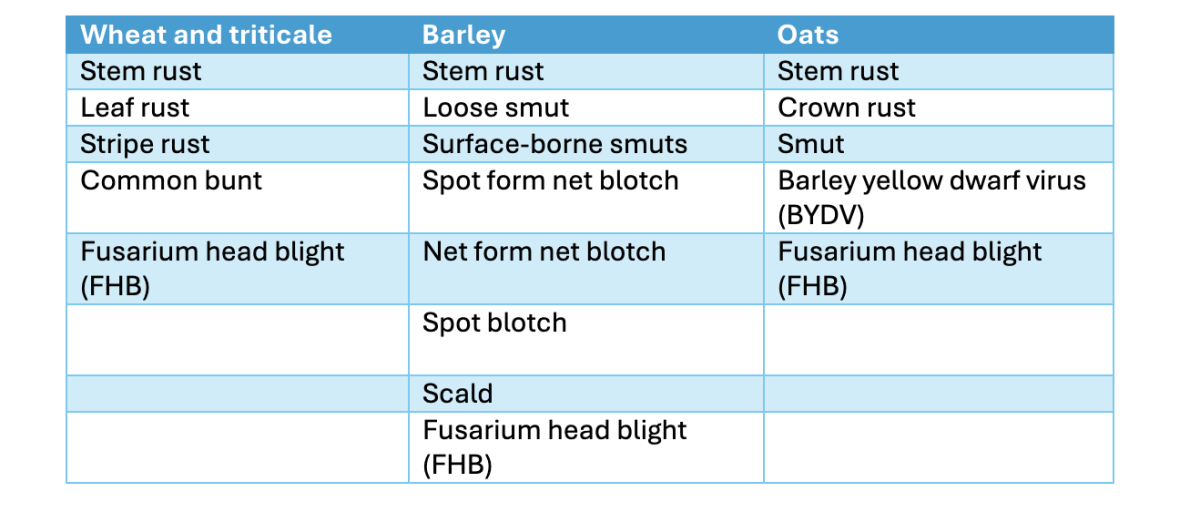
These disease nurseries are artificially inoculated and kept at favourable conditions for disease infection. At the correct timings, diseases are rated through visual assessment and/or lab analysis. The rating results are compared with the benchmark or each susceptibility rating to determine the rating for each site-year. The ratings, from the most susceptible to the most resistant, are:
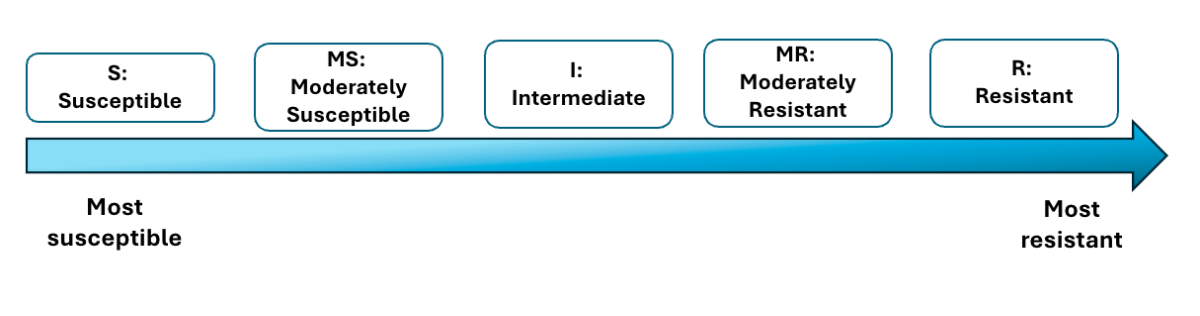
FHB ratings are based on both visual disease symptom assessment and grain DON analysis.
The disease ratings are presented at the PGDC meeting. The voting members of the disease committee vote to “Support” “Object” or “Do Not Object” based on the presented disease ratings, the benchmark for each Priority I disease, and the pathologists’ recommendations.
3. Quality Evaluation Team (QET)
The end-use quality is a crucial factor for the marketability of the grains. Depending on the crop species and class, varieties are assessed extensively based on the respective quality parameters. For bread wheat, the varieties are assessed for their grain protein, milling performance, dough characteristics and baking quality. Feed barley varieties are assessed based on their feed quality, such as crude protein, acid detergent fiber (ADF), total digestible nutrients (TDN), etc. In the case of malt barley, their malting and wort characteristics are thoroughly reviewed by the voting members. Oat varieties are assessed based on nutrition and food processing characteristics, such as grain protein, oil content, ?-glucan, and total dietary fiber.
4. Overall assessment
Once the agronomy, disease and quality evaluation teams had voted for all varieties, on the final day of PGDC, the voting members gather in the annual meeting to make the final decision on registration.
The varieties that are supported by all three evaluation teams are automatically supported for registration.
The varieties that are supported by two out of the three evaluation teams receive a final assessment during the annual meeting. For example, assume a variety is supported by the AET and QET for the superior agronomic and quality traits, but objected by the DET due to poor disease package. This variety will be voted on in the annual meeting on the final day, by the voting members of all three evaluation teams, on the basis of how this variety may impact the producers, industry and end users. The variety will be supported for registration if it receives a majority of the votes.
Post-registration
Once a variety is supported for registration, what needs to happen before it’s available at your local seed retailer?
Year 1
Variety registration
With the support for registration from PGDC, the breeding organizations submit the varieties to Canadian Food Inspection Agency (CFIA) for registration. Registered varieties are legal to be marketed and distributed.
Variety licensing and acquisition
The varieties are licensed to qualified seed distributors through a formal tendering process. From the breeders’ perspective, this process ensures the seed distributors have the technical capacity, market reach and strategic alignment to multiply and market the varieties successfully. From the seed distributors’ perspective, they acquire varieties that have the trait combinations that make them the right fit for the market.
Variety naming
The variety is assigned a common name. During the breeding and pre-registration testing, the lines are named with a combination of letters and numbers. Once acquired by a seed distributor, the variety will be renamed with a common name. For example, breeding line BW5104 is renamed AAC Oakman.
Seed multiplication
In year 1, only a limited amount of seed is produced by the plant breeder. A multi-year seed multiplication process is required to make a small amount of breeder seed into much larger quantities, while maintaining variety purity. In the first year, seed increase is often contracted with a small number of seed growers. In the following years, seed increase may be expanded to more seed growers, depending on the projected market demand. In addition, contra-season production is often done in the southern hemisphere to enable two growing seasons in one calendar year.
Regional variety trial
Breeders and/or seed distributors enter the new varieties into regional variety trials (RVT). In the RVTs, varieties are tested in more geographical locations under different environmental conditions and soil types. The variety performances will be listed on the Alberta Seed Guide tables after 2 years of testing in RVT.
Years 2 to 3
Years 2 and 3 carry forward some of the processes mentioned above. Seed multiplication continues on a larger scale. The varieties continue to be tested in the RVTs till considered “fully tested” after 3 years of testing.
Usually, in the fall of year 3, certified seed is eligible for sale.
Years 4
Year 4, in many cases, marks the first year of certified seed sales to farm customers. In other words, if a variety was supported for registration in February 2023, the earliest availability at your local seed retailer is spring 2026. Often by this time, the variety has been fully tested for 3 years in the regional variety trials. You will be able to find variety performance information on the Alberta Seed Guide.
Conclusion
Variety development is a long process involving trait development, crossing, selection and a vast range of testing. Before registration, varieties are thoroughly assessed by the Prairie Grain Development Committee (PGDC) based on their agronomy, disease and quality traits. After registration, the seeds of the varieties are increased in the following few years before being available at seed retailers. Though a long and complex process, all the steps are put in place to ensure farmers have a diverse pool of varieties to choose from and high-quality seeds to purchase.
Alberta Grains is highly supportive of and involved in the variety development and evaluation processes. Over 50% of the research dollars are invested in breeding-related research that eventually benefit the producers through better varieties. Albert Grains directors and delegates are part of the voting members of PGDC, making decisions on which varieties are supported for registration. The staff are coordinating the regional variety trials that test the varieties post-registration. The final results are the Alberta Seed Guide tables that help with variety selection.
Additional resources
Prairie Grain Development Committee
Procedures for the registration of crop varieties in Canada. Canadian Food Inspection Agency
Variety Licensing. Crop Development Centre, University of Saskatchewan.